
Nowadays, nobody, or very few people, dispute the usefulness of the Internet in business and the need for companies to have at least one website where they can make their services and/or products known to their Clients and Prospects, regardless of whether we are talking about sectors aimed at the End Consumer [B2C] or Business to Business [B2B].
In online stores, where electronic transactions are carried out, it seems more obvious to monitor sales and make a simple cost-benefit equation that helps us to know if the investment in the Internet is proving profitable.
However, in non-transactional Corporate Websites used to publicize services and/or products and from which Contacts or Requests for Quotation are received, most companies ignore the need to control the sales made thanks to the on-line channel and even less the need to calculate the value of other types of interactions with visitors. The web is perceived as a mere showcase or as a static tool to support traditional direct sales through sales reps. This usually happens for one or more of the following reasons:
- Lack of knowledge in the company.
- Lack of resources, either time and/or money.
- The web is implemented as a response to the competition/environment and not because of a conviction that it can really be a differential advantage.
Against this vision, from Reinicia, we believe that the most appropriate is to understand the Corporate Web as another Salesperson in the company, who should be assigned a monthly “payroll” and demand results for the investment made. Its functions should be:
- Attraction of new customers: By attracting new traffic that did not know the company and collecting contacts through forms, emails, phone calls or other means for assignment to the physical commercial network or processing from the head office. Some examples of marketing tools for this function:
- Search Engine Optimization [SEO]: By appearing in search engines for searches related to our services, we will be able to attract new Clients.
- Advertising [SEM and other media]: Attraction of potential Customers by placing advertising, either through text ads or creatives.
- Content Marketing: Generate content that allows us to attract traffic.
- Social networks: Potential customers through these channels.
- Writing in recognized media: If we have knowledge, but we do not want to take on the task of setting up a content area that we have to maintain constantly, we can always enter the world of publishing content by reaching agreements with others who do and who already have traffic. There are many Bloggers who will be delighted that we bring our knowledge to their media.
- Pre-sales and sales support: Reinforcement of the brand image with current customers or old contacts to facilitate sales of the sales team, either by resolving doubts about our products / services or maintaining the relationship over time to, when the time comes, return to make a new commercial proposal or renew the existing relationship. Some examples of marketing tools for this function:
- Chat on-line: To allow the resolution of doubts at the moment when the Visitors are in our web or the proposal of solutions in case they are visiting certain sections.
- Reinforcement content: Generate content and post it on the web to solve the most common doubts that may arise to potential customers in relation to our products / services.
- Newsletter: Procedures should be put in place to capture Prospects’ e-mails, both from web visitors and from those who have contact with the company through any other channel such as the commercial network, trade fairs, business meetings, etc.
- Social Networks: Publication of content related to our products / services and that are useful to users. We can become a reference. Likewise, we will be able to solve their doubts through any of these channels.
- On-line reputation: Controlling what people say about us and our competitors is easier than ever on the Internet.
- After-sales support: offering useful information to customers and taking care of the resolution of doubts and incidents that may arise once they have purchased our product / service:
- Tools such as a Blog, a Wiki or a Knowledge Base, where useful knowledge can be published to get the most out of what they have acquired.
- Newsletter: In order to provide such knowledge to subscribed Customers or to offer support through other means.
- Success stories: Providing examples of how other organizations have taken advantage of the services we provide and giving ideas for improvement.
- Social Networks / Forums / Communities: Platforms through which we can be in direct contact with our Customers and solve their doubts or even allow them to solve them among themselves, and offer them constant support beyond the traditional telephone or email.
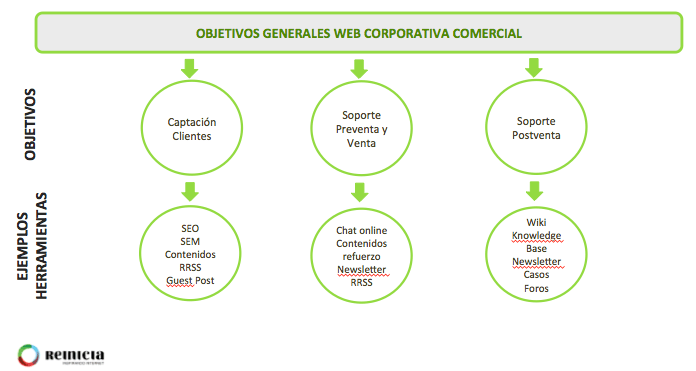
Once it is clear that the Web can be one more Commercial in the company, we will be ready to take the next step, that is to say, to start investing and demanding results.
To do this, the first thing to do is to ask yourself the following questions:
- What do we want our visitors to do on the web that translates into business?
- What will visitors to our website want to do once they are inside?
By answering these questions and seeing what business it could mean for us, we will be able to set appropriate goals for our website. For example, we could set as an objective to get 3 contacts per month requesting a quote for our services through the visits that come to the web. But there may also be other objectives already mentioned above, such as resolving doubts about purchased products or improving the loyalty of current customers.
Conclusion
Therefore, when approaching a Corporate Web project, our recommendation is to move from a vision of a passive and supportive Corporate Web Showcase to a Commercial Corporate Web that serves as a competitive advantage and helps us to actively attract and retain customers. From here, it will be very important to know what will be the objective or objectives pursued by the web.
In the next article in this series, we will look at how to organize objectives and measure them.