In Reinicia, we are convinced that if you work properly the Corporate Web with Commercial Focus, in the medium / long term could become the best commercial of the company, among other things, because the geographical scope is greater and the availability is 24 * 7. That if, the work is NOT easy and requires constant dedication.
If in the previous post about the corporate website we convinced you to change the approach and you are clear that, from now on, the web can help you to actively get business and support Customers, then it is time to start monitoring its performance and for that, the first thing to do is to set goals.
Macro and Micro Objectives
In Web Analytics, these two concepts are very important:
- Macro-objective: This corresponds to the main purpose for which a website is created. For example, in an online store it will be sales.
- Micro-objectives: These are the rest of the questions that your web solves for your visitors and that provide some kind of value to the company. For example, people who subscribe to the Newsletter or Resumes that they send you through it.
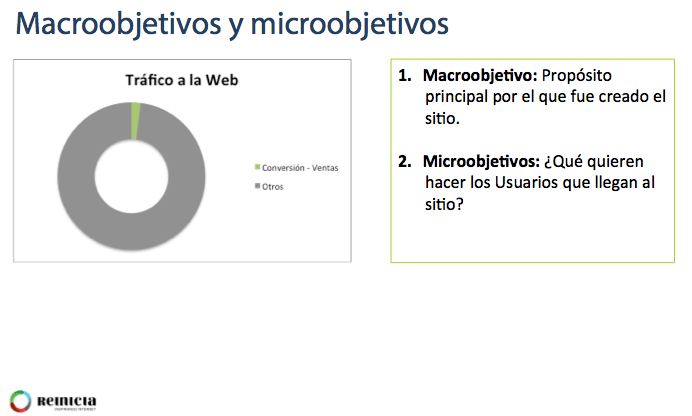
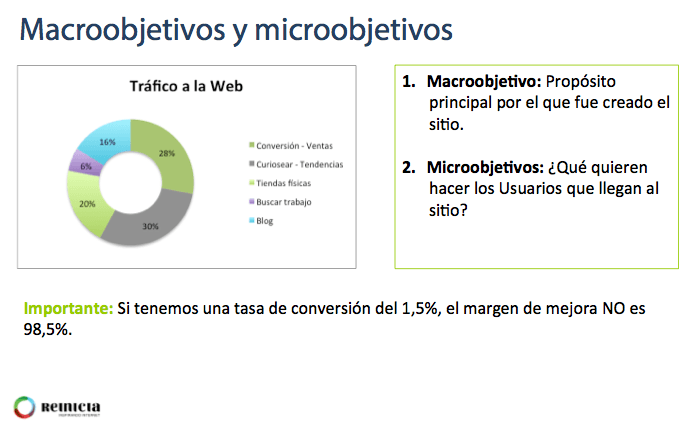
These two concepts are easier to understand if instead of thinking about what we want to offer, we turn it around and think about why our users come to the web. This is very important, since if we focus only on our main purpose, the macro-objective, we will be losing many opportunities, spending efforts to improve aspects of the web that really are NOT improvable and we will be incorrectly measuring the value it brings us.
For example, if we want people to contact us through the web and we have a conversion rate in the contact form of 1.5% [15 contacts / 1,000 unique visitors], this does NOT mean that we have a margin of improvement of 98.5% to increase contacts, because it is impossible that all Users come to the web to contact us. Some people will come to look for our address to stop by our office, others will want to know what we offer before calling us and others are simply in the research phase and will be comparing us with our competition. This means that we will have to control the micro-target of how many people visit the “Where to find us” page and put it in relation to how many come to our office having found us on the web.
 Objectives of the Corporate Web
Depending on what we want to use the Corporate Web for, our objectives will be different. Some examples:
- Acquisition of new Customers: The volume of sales to new Customers closed from contacts made through the web will be the objective, although the number of contacts and their quality [ratio between the number of Customers obtained and contacts received] will be important indicators. In the same way, it will also be interesting to know which products / services arouse more interest or how many visitors subscribe to the newsletter and are interested in what we offer.
- Sale of more products / services to existing customers: The volume of sales made to existing Customers thanks to contacts or actions carried out through the web will be the main objective.
- Pre-sales and sales support: The number of doubts solved or the number of catalogs or other commercial documentation could be the objectives, but also the visit to sections where the company is presented such as “About us”, “Projects”, etc.
- After-sales support: The number of incidents resolved to current Customers or the download of certain manuals that help improve the experience with our products / services.
Calculating the value of the macro-objective
In the case of a Corporate Web with Commercial Focus, the macro-objective can be any of the above. It will depend on where you want to balance the weight of commercial actions: pre-sales, sales or post-sales. That said, it will always end up being reflected in the form of business generation, either directly or indirectly.
The first thing to do to calculate the value of our macro-objective will be to start documenting the contacts made through the web in order to follow up and value them. For example, if we want to give support, we will have to register to whom it is given and if that is converted in the future in some additional purchase or if it renews as a Client. And if the objective is to attract new customers, it will be necessary to register all the contacts of the web and to control if they finally become customers. It is not an easy task, because they will arrive by different means: a form, e-mails to the e-mail account that appears on the web, phone calls or any other channel that we have enabled for contact… But it is possible!
Tools such as Google Analytics, Jiraffe or Omniture allow us to keep track of the number of contacts received through the Web through the functionality of conversion paths and events, but to control the phone calls received in the company as a result of previous visits to the web or emails received to the classic “info@miempresa.com”, it will be necessary to start asking how they met us, although it is obvious that it will not always be possible, and document it month by month.
From here, it is essential to know how many of them become customers and what revenue and benefits they generate, i.e. the value they produce for the company. The focus should be on achieving conversions that generate revenue for the company, beyond the useless objective of simply getting visits.
Once we have been working with the web for some time, we recommend a minimum of six months, it will be very useful to calculate the estimated value of future contacts, because this way we will be able to know better how much is worth investing in the web and we will be able to control the performance month by month:
Net margin of customers obtained with the Web in the period / Number of contacts received in the period
In case we are just starting, to estimate the estimated value of each contact and thus know the value produced by the web in its beginnings, it would be enough to make the following equation with data extracted from the sales program:
Average net customer margin / Number of contacts required to win a customer
- Average net customer margin: How much does each of our customers bring us on average? This information is in the company’s accounts. Simply divide the Total Net Margin by the number of Customers in its simplest version.
- Contact Acceptance Rate: How many contacts does it take to get a Customer? For example, on Agencia Reinicia we need 10 contacts through the web to make 1 Customer.
Example: $600 / 10 contacts = $60 [Value of each contact].
Of course, contacts coming in through the web may be of different value than those coming in through other means, but if you don’t have data, this may be a rough way to get it.
In this way, although at the end of the year we will take stock to know if the investment has been worthwhile, with the Estimated Average Value of a Contact, we will be able to know the return that the website will probably bring us month by month based on the contacts we are receiving.
Finally, at the end of the year, it will be necessary to take stock and verify that the net margin produced is greater than the investment made:
Net margin web customers – Web investment > 0
Calculating the value of the Micro Targets
However, it should be borne in mind that, in addition to the macro objective, there will be other micro objectives to measure in order to really know the total value that the website is providing. Of course, the important thing is the macro-objective, but these micro-objectives should not be neglected. The visit to certain sections, the subscription to the Newsletter, the search for branches, the subscription to a Blog RSS, the number of incidents received and solved through the web, the rate of fulfillment of the tasks of the Users in the web, etc. Whatever they are, all of them can and should be valued economically because in one way or another, they will generate business in the future.
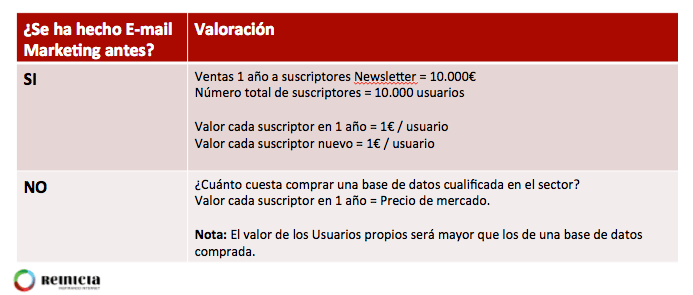
To give you an idea, let’s give an example of how we could estimate the value of each new subscriber we get for the Newsletter. We will differentiate between if we have previously done e-mail marketing or if we are going to start using this tool:
Total Economic Value of the Web
This same procedure will have to be applied to the rest of the micro-objectives, which added to the value contributed by the micro-objective, will give us the Total Economic Value of our Web. This value is the one that we will really have to control over time and which will tell us if our web as an asset is growing or decreasing.