In the digital marketing universe everything is constantly evolving. It is necessary to update knowledge and technical aspects on a recurring basis to maintain or increase the relevance of your business within the sector. If we focus on the section of data privacy, the constant regulations of the Data Protection Act (RGPD), the Cookies Act or the Digital Markets Act (DMA), make necessary changes within the websites to comply with all current regulations, and thus avoid penalties or loss of relevant information.
Last January, the Cookie law was updated, while the Digital Markets Act, which began its process of change at the end of 2023, set a deadline of March 6 to comply with all its requirements. The regulation governs the tracking of users through cookies – both for analytical and advertising purposes – and has brought an immediate response from Google: its new Consent Mode V2. An update of the already existing version 1, which had been implemented years ago.
At Agencia Reinicia we will explain everything you need to know about Google Consent Mode V2 so that you can continue to optimize your business based on real data in an effective way.
At Reinicia_ we implement Consent Mode V2 on your website.
New Cookie and Digital Marketplace Laws in 2024
The new Digital Markets law in Europe dictates that explicit permission must be obtained for the collection and use of personal data of European citizens, both in advertising and analytical research. It refers to the blocking of Third-Party Cookies, which are necessary for the use of the personalized ads or remarketing function through Google Ads.
This is in addition to the update of the cookie law (which came into force in January 2024), where the main change marked that the ‘Reject Cookies’ button should be visible, with the same font and color as the ‘Accept Cookies’ button. This marks a considerable change in this respect, as a large majority of users will refuse cookie consent, influencing the amount of actual data obtained.
Failure to comply with such laws will result in the possibility of fines, which could amount to up to 10% of the company’s annual revenues. In the event of a second penalty, the figure could rise to 20%. This is where Google’s Consent Mode V2 comes in. Its function is to keep websites and businesses within the law with the least possible harm when it comes to capturing relevant data, used for both analytics and advertising purposes.
What is Consent Mode V2?
Consent Mode V2 is the solution provided by Google to help website owners to comply with all legal regulations related to data protection in force, while still obtaining the benefits that platforms such as Google Analytics or Google Ads bring to each of the businesses related to such websites.
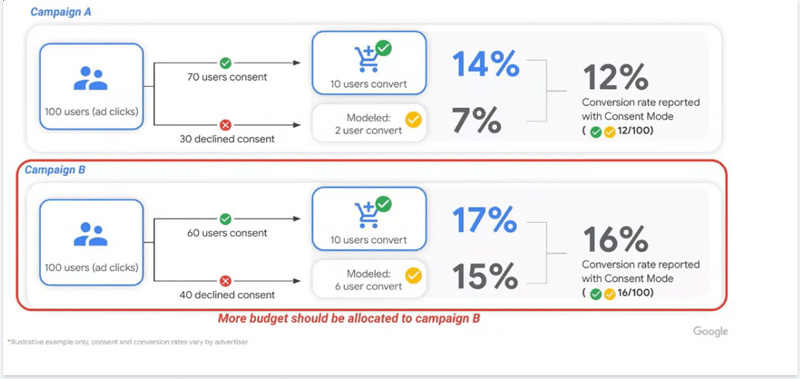
With it, analytical and advertising measurement will continue to be optimal when creating personalized campaigns, defining audiences or creating segmentations. Consent Mode V2 avoids the loss of information of all those users who reject the tracking in the initial cookie banner, since through data modeling -which uses previous behaviors of users who did accept consent-, information is obtained from between 60% and 70% of these users, minimizing the loss of these users.
Difference between Consent Mode V1 and V2
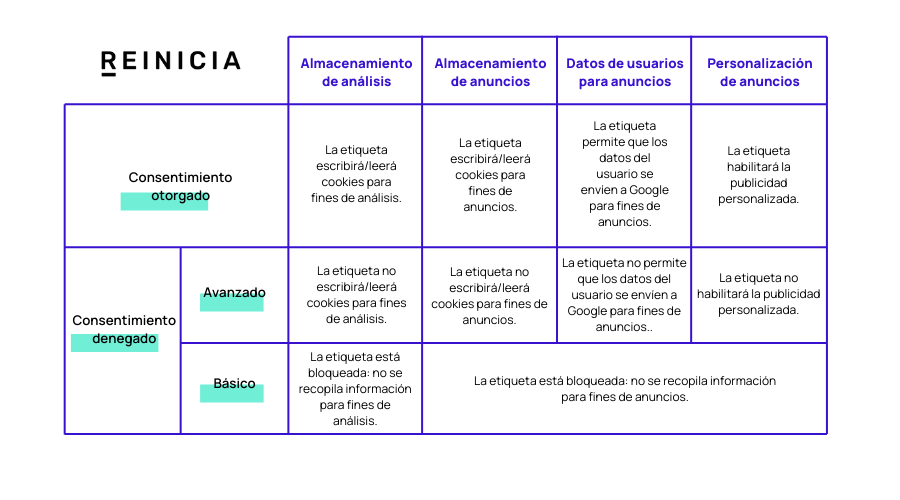
The difference between the two versions lies in the parameters that are collected. V1 only referred to ad_storage (data storage for marketing purposes) and analytics_storage (data storage for analytics purposes). In V2, however, two new parameters have been added, related to the advertising part:
- ad_user_data: Users will indicate whether they want to submit their data for advertising purposes. This encrypted data will be sent to Google.
- ad_personalization: users will indicate whether their data will be used for remarketing purposes to receive personalized ads.
Benefits of using Consent Mode V2
The implementation of Consent Mode V2 will have two main advantages:
- Analytics. Related to Google Analytics. With its implementation, the massive loss of user data, sessions and other essential metrics/dimensions will be avoided.
- Advertising. Related to Google Ads. It will be possible to keep the option to create personalized ads and to make use of remaketing. With the blocking of third-party cookies by Google in March 2024, it will be mandatory to maintain this practice.
How to configure Consent Mode V2
There are two possibilities when configuring Consent Mode V2. On the one hand, there is a manual option, with the insertion of a Javascript code, which will give the necessary guidelines for the use of the data of users who have accessed the website. This option is the least recommended, since any small change can lead to errors in the processing of consent.
Using a recommended CMP with Google, along with Google Tag Manager, will be the easiest and most optimal way to implement Consent Mode v2 on your website.
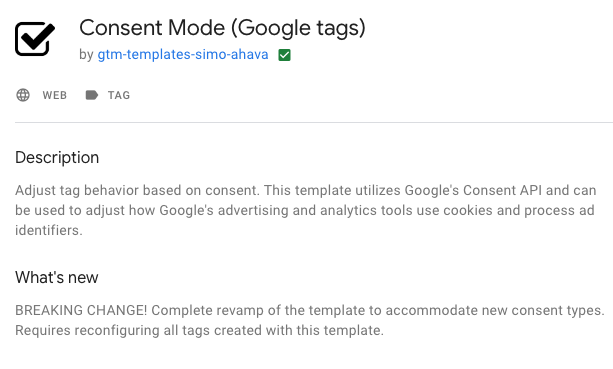
Many of the CMPs have templates integrated into Google Tag Manager so that Consent Mode V2 can be used directly. The most used and recommended are Cookiebot, Complianz and One Trust (Templates >Import tag templates).
To carry out this process, it is necessary to enable the consent summary in Google Tag Manager (Administrator>Container Configuration) and configure the CMP template previously chosen (Tags> Click on CMP tag). Each CMP will have its small variants within the template, but in all of them it will be an agile and not too complex process. In case of not having a CMP with its own template in Google Tag Manager, there is the possibility of implementing Consent Mode V2 by creating tags, triggers and variables.
Consent Mode V2 Implementation Modes
There are two different ways to implement Consent Mode V2 on your website: basic and advanced.
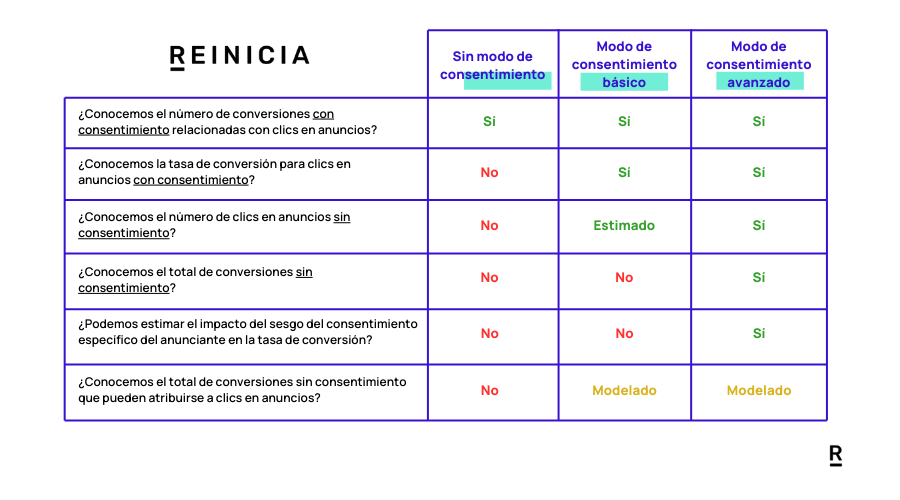
Basic mode: Its purpose is to maintain the legality of what is required according to the latest changes in the laws of Cookies and Digital Markets. In this case, all first-party cookies would be blocked, something 100% legally required in 2024. They will only be changed to ‘granted’ -accessible for Ads, Analytics and other external platforms to Google- once the user accepts them. In case of refusal, Google will not do any modeling, so all these data would be irreversibly lost.
Advanced Mode: This is the recommended mode for the implementation of Consent Mode V2. With the advanced mode, Google will send information pings of those users who have not accepted cookies in the initial banner. This anonymous information will be used to improve data modeling progressively. Google will use statistical techniques to estimate and create more accurate data. It will also enable ad personalization, once third-party cookies were no longer allowed on March 6.