TABLE OF CONTENTS
Today, with competition fierce and customers increasingly demanding, companies need all the tools available to increase their productivity and stay ahead of the curve. The combination of CRM and Artificial Intelligence has become one of the most powerful strategies to achieve this goal.
Are you ready to make the leap to a more efficient CRM intelligent? The combination of Mailchimp and Zoho CRM with Artificial Intelligence (AI) is the answer you’ve been looking for.
It’s time to welcome a brighter future intelligent in your business!
Why should I use artificial intelligence in my marketing strategy?
In an increasingly digitized and competitive market, AI has become an indispensable tool for companies looking to optimize their strategies and offers a wide range of benefits that can help you:
- Obtain information when exporting customer data.
- Empower personalized interactions with customers through customized tailored content.
- Reduced human error for improved accuracy and efficiency.
- Optimization of data management for a more efficient data flow.
- Maximize Return on Investment (ROI).
- Detect and take advantage of emerging trends.
Why does your business need AI in its CRM?
A CRM system is designed to understand and plan strategies that drive conversion and sales of a company’s customers. Its primary function is to collect information from a variety of sources, such as emails, orders and forms, to identify behavioral patterns and customize offers to specific customer segments.
The integration of artificial intelligence has significantly boosted CRM performance, offering a holistic view of the user experience, from acquisition to retention. This contributes to a stronger and more successful commercial strategy. An AI-powered CRM can identify areas for improvement in customer service, ensuring a more satisfying experience.
Automation of key tasks is essential to achieve objectives, as the software can perform both administrative functions and data analysis. This capability not only saves time and reduces costs, but also optimizes efficiency and provides valuable insights to personalize the customer experience in digital channels, reducing decision bias.
This combination makes it possible to discover new growth opportunities and anticipate market trends. In short, integrating artificial intelligence into a CRM optimizes both the sales process and the customer experience.
Attend the free AI + CRM webinar to accelerate your business!
Main advantages of AI in CRM
Before delving into the many benefits that artificial intelligence brings to a CRM system, it is crucial to stress the importance of proper preparation. The effectiveness of implementing AI algorithms in a company’s CRM depends on the prior identification of various data sets. These sets, when combined, map a complete customer typology, allowing to optimally respond to the unique needs and preferences of each customer.
Through data analytics and machine learning, interactions with each customer can be personalized, taking into account factors such as purchase history, demographic group to which they belong or browsing behavior. With this solid foundation, let’s explore the main advantages of integrating AI into a CRM to boost efficiency and customer satisfaction.
- Optimization of new customer acquisition
The integration of artificial intelligence has proven to be a valuable resource in the formulation of strategies aimed at attracting and acquiring new customers, as well as generating qualified leads. Its ability to analyze large volumes of data and extract relevant information makes it an essential ally in this process.
When it comes to creating strategies for customer acquisition and qualified lead generation, artificial intelligence is the ideal partner. By combining acquisition and remarketing campaigns with customer clustering, it is possible to design more focused and precise campaigns, transforming visits into successful sales.
- Increased sales
This advantage represents one of the most notorious and valuable benefits for any company. Artificial intelligence makes it possible to process considerably larger volumes of data .
This data, when properly analyzed, becomes knowledge, providing accurate information on aspects such as purchasing trends. Ultimately, this information is used to make more informed decisions and optimize the sales process, campaigns andcustomer interaction.
- Task automation and time optimization
AI enhances CRM’s ability to perform tasks faster and more accurately than humans. This enables increased automation of repetitive or routine processes, such as data entry or retrieval, which significantly reduces manual workload and errors by employees.
This increased efficiency translates into greater productivity and job satisfaction, allowing employees to focus on higher-value tasks, such as building customer relationships and optimizing their sales funnel.
In addition, virtual assistants or chatbots play a crucial role in automating administrative tasks or basic support functions. Well-trained chatbots can answer frequently asked questions, provide product recommendations, follow up on orders, manage contacts, take notes and even process simple transactions.
- Increased loyalty
A satisfied customer tends to be loyal. Therefore, having knowledge of the emotional state of customers enables the creation of a more effective communication strategy, the ability to act proactively and the optimization of the customer experience.
In this perspective, artificial intelligence tools can collect, analyze and visually present how customers perceive the products and services you offer and the way you communicate with them.
In this case, the use of chatbots can analyze and assess customer conversations, identifying and evaluating their feelings, including satisfaction and frustration. Understanding customers’ emotional states can increase revenue per customer by 10%.
- Specific segmentation
Artificial intelligence-driven CRM systems simplify the process of categorizing customer data into defined segments. This enables the creation of highly specific audience segments, tailored to the particular objectives or outcomes the company is seeking, considering geographic, demographic, psychographic, behavioral and sentiment analysis data.
By gaining a deeper understanding of its customers, a company can tailor the interaction and thus improve the effectiveness of planned actions, whether it is tracking an order or promoting a product or service. An example of the application of artificial intelligence in marketing is the generation of personalized messages or experiences based on each customer’s profile.

- Improve customer experience
Gaining a deeper understanding of the target audience’s expectations is essential to establish an emotional bond between the brand and the customer. In this context, the customer perceives that his needs are understood. Beyond just satisfying their specific demands with personalized offers, the goal is to strengthen their loyalty and long-term commitment through strategically designed actions.
This approach is known as “hyper-personalization of the experience” and is essential for implementing effective customer loyalty strategies. By having a deep understanding of their needs, companies can offer specific product recommendations tailored to their demands.
In improving the customer experience, the development of enhanced applications with more intuitive and user-friendly interfaces also plays a crucial role. This ensures a high-quality experience that undoubtedly contributes to boosting conversion rates and sales.
- Reduction of the abandonment rate
Artificial intelligence-driven tools have the ability to recognize patterns and trends in the reasons that lead to churn. This allows the company to take a predictive approach, implementing strategies designed to reduce churn. It is important to remember that retaining a customer is easier and, above all, less costly than acquiring a new one.
Thanks to the application of AI in a company’s CRM, it is possible to keep data better optimized, avoiding inaccurate predictions and enabling the detection of potential problems. Artificial intelligence also suggests personalized actions to solve them, such as identifying and correcting incomplete or duplicate data by consulting other channels.
More than 90% of companies with ten or more employees use a CRM to optimize their processes and improve efficiency. This underscores the relevance that the integration of artificial intelligence and CRM powers data analytics, providing additional value to the continuous improvement of business efficiency.
Artificial Intelligence applications in your CRM strategy
The incorporation of artificial intelligence in CRM is highly beneficial to companies at any stage of their development, significantly improving various areas both internally and externally. Here are some of its key applications:
- Accelerated content production: By processing massive amounts of data, such as emails, comments and reports, AI can generate accurate content to create effective communications.
- Recommendation systems: By thoroughly understanding customer needs, AI recommends specific products according to their demands, thus optimizing the personalization of the customer experience. According to Salesforce, this personalization can increase sales by 10%.
- Sales forecasting: The core area of CRMs is sales, and AI significantly improves forecasting accuracy by processing data. This allows companies to adjust strategies and optimize their sales.
- Predictive lead scoring: AI assesses a customer’s readiness to buy, focusing efforts on potential prospects and providing insights on won and lost business.
- Virtual assistants: AI makes it easier to manage routine tasks, such as managing calendars, scheduling meetings and making phone calls, by automating various functions.
- Data capture: AI simplifies the capture of customer data from various touch points, such as social networks, SMS and images. It also automates data entry, reducing the time sales reps spend manually entering information.
This combination of AI and CRM is a competitive advantage in today’s business environment, with significant potential to positively impact GDP and generate employment globally, according to a report from IDC and Salesforce.
Zoho and Mailchimp as potential CRM tools
Zoho and Mailchimp are two CRM tools that have gained great notoriety in the world of marketing and customer relationship management. Both platforms stand out for their focus on optimizing relationships between companies and their customers, including advanced tools for tracking, automating and personalizing customer interactions. While they differ in several respects, they share the fundamental goal of helping companies better understand and serve their customer database.
Zoho CRM is a comprehensive solution that covers everything from contact and opportunity management to sales and marketing automation. It has reports and analytics dashboards to see the evolution of contact management. In addition, it integrates with other applications in the Zoho suite, such as Zoho Campaigns, which is like the perfect companion for your email marketing campaigns. As a CRM it is very complete and that also requires more knowledge to handle.
Mailchimp, on the other hand, although it also functions as a CRM, is better known for its focus on email marketing and automations. Apart from developing effective and segmented email campaigns, it allows the creation of automated workflows that are triggered based on customer behavior, ensuring more personalized marketing. As a CRM it is simpler and more intuitive to use than Zoho but, consequently, it has fewer features.
Both tools are complementary and can be used together to optimize customer interactions throughout the customer lifecycle. The choice between these two tools will depend on the specific needs of your company and how you want to approach your customer relationship management.
How does Artificial Intelligence work in Zoho CRM?
Zoho’s implementation of Artificial Intelligence (AI) has brought significant improvements to Zoho CRM functionality. This translates into more accurate and valuable data analysis for users. Some of the highlights include:
- Predictive analytics: Zoho CRM’s AI has the ability to analyze customer behavior patterns and sales trends in a way that enables accurate predictions about future business performance. As a result, companies can make informed decisions regarding their customer management and sales strategies.
- Automation intelligent: Zoho CRM automates repetitive tasks, such as data entry and scheduling tasks, alerts, notifications. This automation saves valuable time for users and allows them to focus on crucial activities, such as interacting with customers.
- Personalization: AI offers personalized recommendations based on customer data, such as buying patterns or product preferences. This enables users to deliver more tailored and satisfying experiences.
- Intentionality analysis: Zoho CRM’s AI analyzes customer interactions with the company (emails, calls, etc) to identify intentionality in communications. This capability empowers users to identify challenges and opportunities for improvement in customer interactions.

Other Zoho tools and services that include AI
Zoho AI, the artificial intelligence platform developed by Zoho, offers a wide range of services and tools for both developers and users to power their business applications. Some of these services are:
- Zia: Zoho’s virtual assistant that simplifies tasks in applications such as CRM, Human Resources and Finance, offering a more efficient experience.
- Zoho Desk: This customer service platform leverages artificial intelligence to improve the interaction of support agents with customers, providing a quality experience.
- Zoho Analytics: A powerful data analytics tool that uses artificial intelligence to extract relevant and insightful information from business data.
- Zoho Invoice: An invoicing solution that automates the invoice issuing process and reduces errors thanks to artificial intelligence.
Zoho remains committed to continuous development in the field of artificial intelligence, with the goal of improving the user experience and offering smarter, more personalized products.
At Reinicia we are Zoho partners and we are here to help you get the most out of your applications 😉. You know, from the initial configuration to the automation of processes, through the training of your team and any questions you can think of.
AI applications in Mailchimp
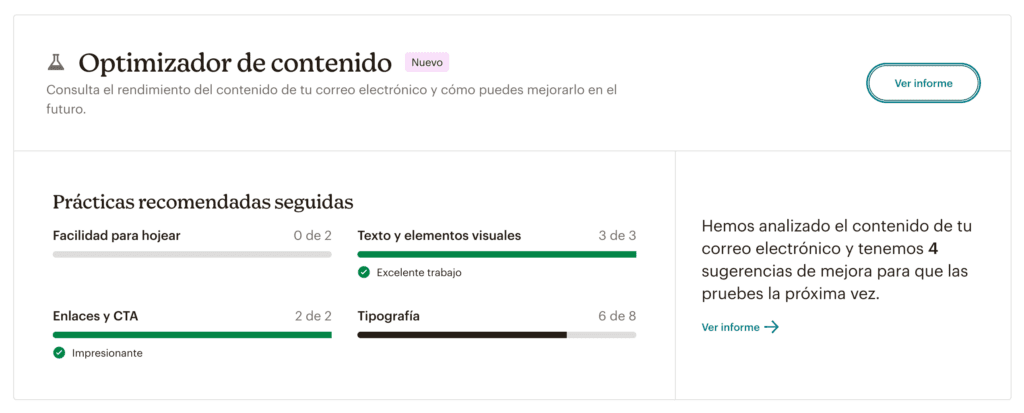
Content optimizer
It analyzes your campaigns and offers you possibilities for improvement in terms of design and usability to boost the CTR of your email marketing campaigns.
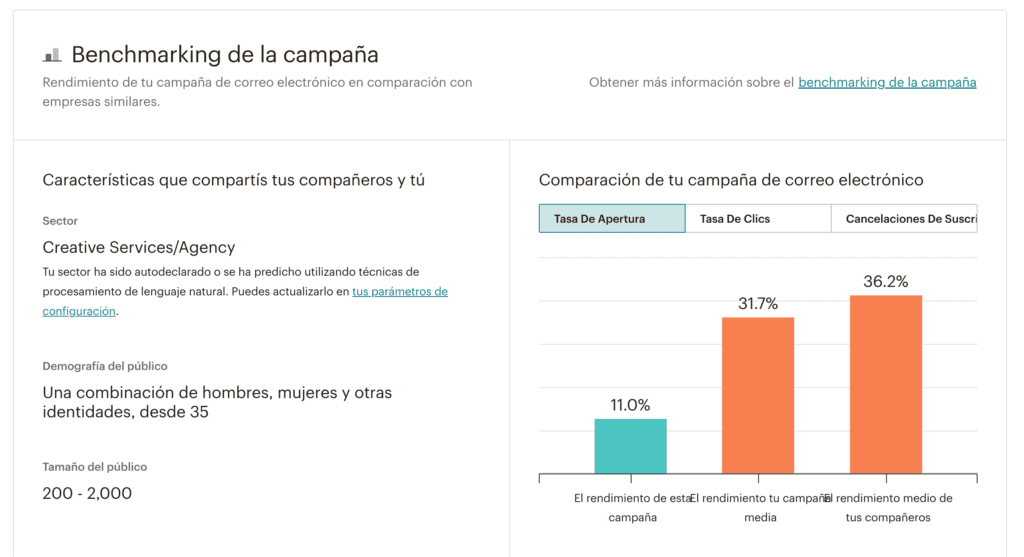
Predictive campaign benchmarking
The campaign benchmarking feature leverages cutting-edge data science to compare how your email marketing strategy performs against other competitors in the market.
Creative Assistant
Mailchimp’s creative assistant understands your brand and is able to generate designs that will increase visibility and traffic for your business. They apply both design best practices and artificial intelligence to make sure your multichannel campaigns are visually appealing and consistent. In addition, it allows you to easily edit, resize and publish your designs.
Some of Mailchimp’s applications where artificial intelligence is at work are:
- Pre-designed and custom-coded e-mail templates
- A/B and multivariate tests
- Improved automated customer journeys
- Personalized onboarding
- Predictive segmentation
- Time of dispatch based on higher probability of opening contacts
As a Mailchimp partner we offer services ranging from strategic consulting and custom configuration to campaign management and data analysis. We can help you maximize your use of Mailchimp and improve your email marketing strategies, so don’t be shy to ask us any questions! 😄